
WATER TREATMENT FOR THE WHOLE HOME
Technical Specification Sheets and reduction Capabilities
HELLO Water WHOLE HOME WATER FILTRATION BY "TRY COMFIRT AIR"
Hello Water Whole home water filtration systems are designed, Engineered and Manufactured by Pentair to provide clean, filtered water to every tap and appliance in your house. These systems typically connect to your main water line and remove impurities such as micro plastics sediment such as rusts, mud and silt, chlorine, chloramine and volatile organic chemicals, heavy metals, and other emerging contaminants such as PFAS, ensuring safer and better-tasting water. They can also help protect plumbing and appliances from scale and buildup caused by minerals. Ideal for families looking for comprehensive water quality improvement, these systems offer convenience and peace of mind.
POTENTIAL MUNICIPAL WATER CONTAMINANTS
- Chlorine – While chlorine is important for killing waterborne bacteria, too much chlorine can give water an unpleasant taste, as well as irritate skin.
- Chloramine -Municipalities may use chloramine to disinfect municipal water. Chloramine is five parts chlorine and one part ammonia.
- Cysts -Parasites that can be found in water, such as Giardigand Cryptosporidium which are resistant to traditional agents like chlorine; therefore, municipal water treatment may not totally remove them.
- Lead -Lead can enter groundwater from industry or mining sources, or can leach into water as lead pipes used in older homes corrode. Both tasteless and odorless, elevated levels of lead can potentially cause developmental delays in children and could contribute to elevated blood pressure in adults.
- Sediment -Sediment such as sand, silt, rust, and mineral particles can give water a cloudy appearance and can cause significant wear on plumbing and household appliances.
- THM -Tri Halo Methane are a group of chemical form as by-products during the disinfection of drinking water THMs are considered carcinogenic and may pose risks with long-term exposure
Hard Minerals-High concentrations of dissolved minerals can lear
to damaging scale buildup on plumbing and water-using appliances resulting in costly repairs. Examples include calcium and magnesium. - Microplastics -Microplastics typically range in size from 5 millimeters (about the size of a sesame seed) down to 1 micrometer (a thousandth of a millimeter).
- Magnesium -A natural element found in rocks deep underground. Magnesium and calcium are two main cations that cause hardness in water.
- Acid – Overly acidic water tastes metallic or sour. It can stain laundry, sinks and drains, and damage plumbing and appliances. Low pH can lead to leaching from plumbing fixtures.
- Iron -Excess iron can lead to corrosion and manifest as stained fixtures, discolored water, red-orange or orange-brown stains and an unpleasant metallic taste.
Calcium -An important determinant of water hardness, calcium in high levels can cause mineral buildup on appliances and fixtures. Skin and hair can also be negatively affected. - Magnesium -A natural element found in rocks deep underground.
Magnesium and calcium are two main cations that cause hardness in water. - Sulfate -A salt that is formed when sulfuric acid reacts with
another chemical element. High levels of sulfate can corrode plumbing, especially copper piping, and result in a bitter, unpleasant taste. - Sulfur – An element that exists in nature and can be found in soil, plants, foods, and water. Sulfur causes an unpleasant smell, commonly referred to as “rotten egg” odor.
- Tannins -A naturally occurring polyphenol found in plants, seeds,
bark, wood, leaves, and fruit skins. Tannins can cause yellow water and staining on fabrics and fixtures and cause an earthy, musty, or bitter smell and taste in the home’s water. At 5 ppm or higher, they can interfere with other water treatment processes.
TDS (Total Dissolved Solids) High levels of TDS in ground water can have an unpleasant salty, bitter, or brackish taste, depending on the water’s composition. Different water sources contain different substances that are present as TDS. - VOC -Volatile organic chemicals include components of gasoline and industrial cleaners, which can lead to potential health concerns.
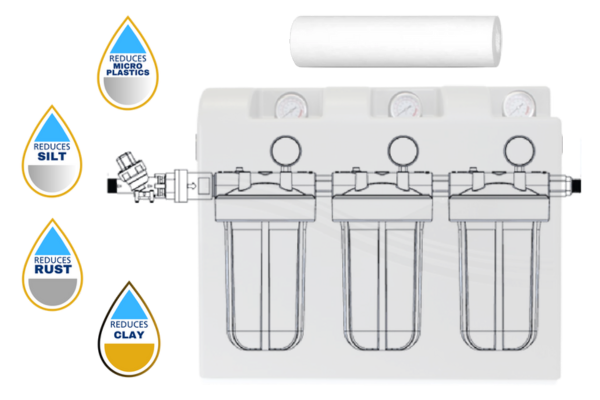
5 LEVEL 3 STAGE WHOLE HOME FILTRATION SYSTEM FILTRATION CARTRIDGES
- DGD SERIES (GRADIENT DENSITY CARTRIDGES)
- RFC SERIES (RADIAL FLOW CARBON CARTRIDGE)
- PREMIUM HEAVY DUTY
- Coconut Granular Carbon + KDF, HEAVY METALS AND EMERGING CHEMICALS REDUCTION FILTER CARTRIDGE
- HIGH FLOW LEAD PROTECTION
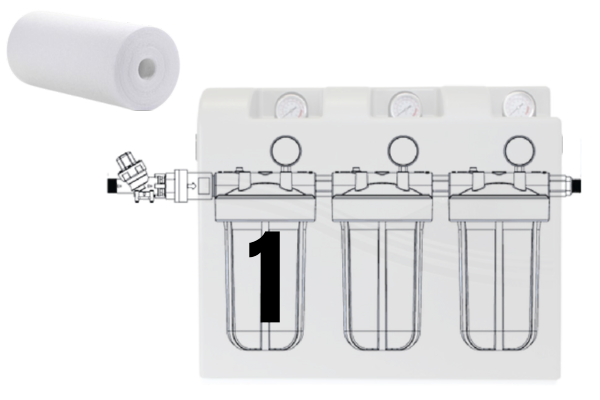
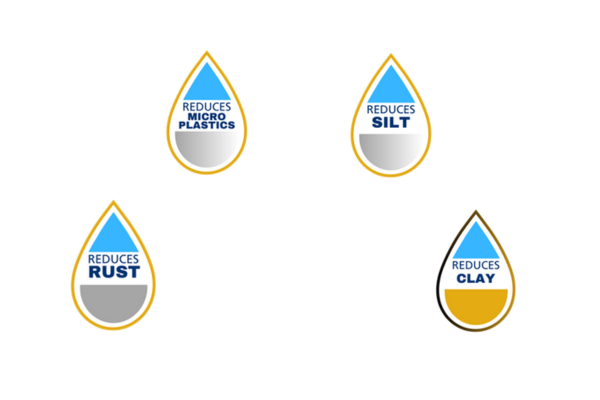
DGD SERIES (GRADIENT DENSITY CARTRIDGES)
DGD Series Cartridges are manufactured from 100% pure polypropylene and are sized for use in Pentair Pentek Big Blue Filter Housings.
DGD Series Cartridges are designed for purity and will not impart taste, odor or color to the liquid being filtered.
Additionally, the polypropylene construction provides superior chemical resistance and is not prone to bacterial attack. The DGD Series’ advanced design combines selective final filtration with appropriate pre-filtration to achieve up to three times the dirt holding capacity of similar size sediment cartridges and even greater capacity than standard spun or string-wound cartridges. The larger diameter of the filter reduces the particle load, allowing it to operate at higher velocities. The effective filter depth is increased to a full 233%. This increased depth provides very high particulate
reduction efficiencies and added loading capacity.
The design and performance characteristics of the DGD Series Cartridges make them an excellent choice for all residential, rural, municipal and commercial applications.
FEATURES/BENEFITS
- Manufactured from pure 100% polypropyleneSpun fibers form
- Designed for purity and chemical compatibilityinner surfaces
- a gradient density from outer to Nominal 0.5, 25 micron ratings
SPECIFICATIONS
- Filter Media – Polypropylene
- Temperature Rating – 40-145°F (4.4-62.8°C)
- a gradient density from outer to Nominal 0.5, 25 micron ratings
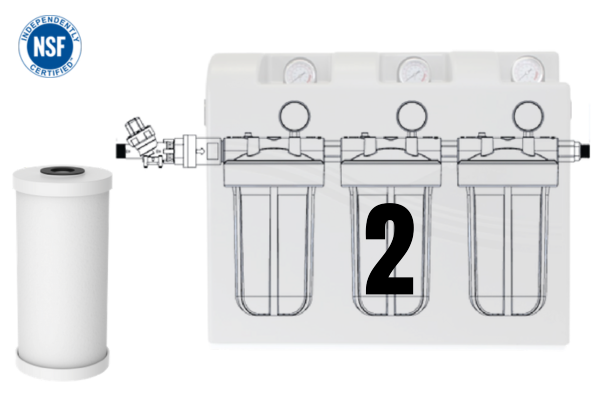
RFC SERIES (RADIAL FLOW CARBON CARTRIDGE)
Catalytic Granular Activated Carbon (GAC) is a highly porous material widely used for water purification due to its exceptional adsorption capabilities. It removes chlorine via adsorption and uses its enhanced catalytic properties to break down chloramines into ammonia and chlorine, which are then adsorbed or removed.
Also It effectively removes organic compounds, pesticides, herbicides, and industrial pollutants through adsorption. It also tackles unpleasant tastes and odors
FEATURES/BENEFITS
- Provides effective chlorine taste & odor reduction*
- Pentek RFC Cartridges are ideal for reduction* point-of-entry (POE) and other high flow rate applications
- Unique design reduces carbon fines in filtered water
- Available in a wide variety of sizes
SPECIFICATIONS
- Filter Media – Granular activated carbon
- Gaskets – Buna-N Core Polypropylene
- Outer Shell – Polyethylene
- Endcaps – Polypropylene
- Temperature Rating 40-125°F (4.4-51.7°C)
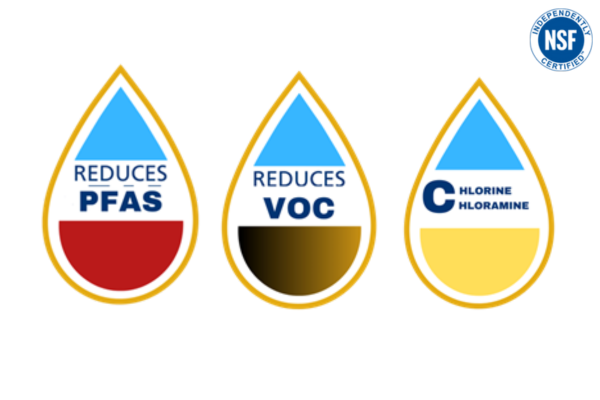
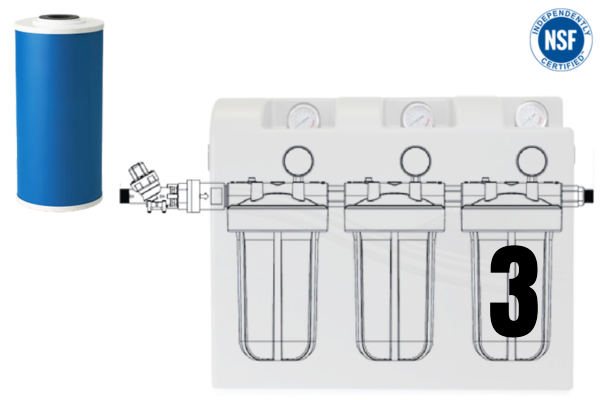
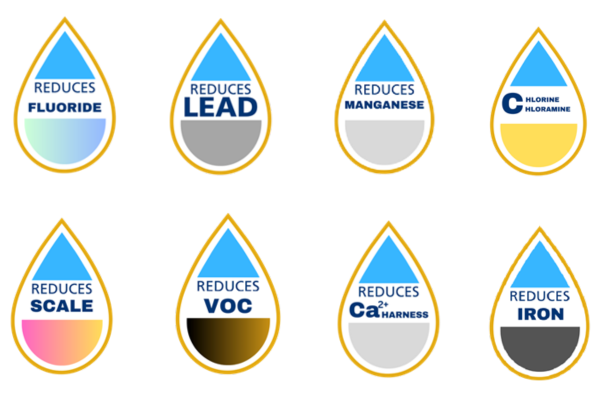
PREMIUM HEAVY DUTY
Coconut Granular Carbon + KDF
HEAVY METALS AND EMERGING CHEMICALS REDUCTION FILTER CARTRIDGE
HIGH FLOW LEAD PROTECTION
Pentair UDS & DBC Series Cartridges are enhanced with KDF media to inhibit scale buildup that can damage equipment. These cartridges are constructed of high performance coconut granular activated coconut shell carbon and a 5-micron spun bonded polypropylene post sediment element for increased dirt holding capacity. They are also effective for chlorine taste and odor reduction in high capacity situations and where lime and scale buildup problems occur.
FEATURES/BENEFITS
- Bodies are constructed with high Designed to fit almost all standard housings grade polypropylene or polystyrene (UDS-10EX1) and Big Blue housings (DBC- 10EX2)
- Spin and sonic welding assembly assures a uniform hermetic seal
- Great for reverse osmosis, which improves overall reliability distillation, bottle-less coolers, and other water dispensing appliances
- Cartridge volumes are some of the highest in the industry
SPECIFICATIONS
- Filter Media – Granular activated carbon
- Gaskets – Buna-N Core Polypropylene
- Outer Shell – Polyethylene
- Endcaps – Polypropylene
- Temperature Rating 40-125°F (4.4-51.7°C)
TECHNICAL SPECIFICATION*
BOTTLE WATER PLANT
SYSTEM FEATURES/BENEFITS
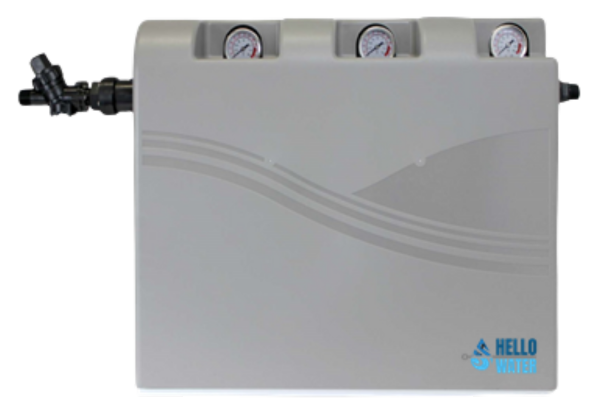
- Compact and durable design Durable Pentair housings, cartridges, and components
Low pressure loss with a consistent flow rate of 75 liters per Three pressure gauges to indicate remaining cartridge life minute Inclusion of a pressure regulating valve and a dual check.
Capable of upright installation on a concrete plinth or wallvalve mounting Cartridge lifespan exceeding 12 months, with a maximum of 16 months
- UV-resistant HDPE cover to protect the system
REDUCTION CAPABILITIES
SEDIMENTS
- Micro plastics
- Rusts
- Mud particles
- Silt
Sand particles
CHEMICALS
Chlorine
Trihalomethane
Chloramines
Nitrate
Barium
Arsenic
- Cadmium
Chromium (VI)
Chromium (III)
Selenium
Sulfur
Endrin (C9H6Cl6)
Lindane (C6H6Cl6)
Methoxychlor
Toxaphene
Aluminum
Calcium Hardness
Magnesium Hardness
Magnesium Hardness
HEAVY METALS AND EMERGING CONTAMINANTS
- Lead
- Mercury
- Silver
- Iron
2,4-D
ANTI MICROBIAL ACTIVITY
- Control of the BioFouling
- Legionella pneumophila (Philadelphia 1 strain)
SYSTEM CERTIFICATIONS AND STANDARDS *




WATER FACTS
KNOW YOUR WATER
Municipal Tap Water: Municipal water quality refers to the safety and cleanliness of the water supplied to homes and businesses through public water systems. While municipal water is treated to meet health and safety standards, it can still contain certain chemicals and impurities. Common additives include chlorine or chloramine, which are used to disinfect water and kill harmful microorganisms. Fluoride is often added to prevent tooth decay.
However, Municipal Tap water may also contain impurities such as sediment, heavy metals (like lead or copper), pesticides, industrial chemicals, and trace amounts of pharmaceuticals. These can enter the water supply through aging infrastructure, agricultural runoff, or industrial waste. While the levels of these impurities are generally regulated, they may still pose concerns for some individuals, especially those with specific health conditions or sensitivities. Whole home or point-of-use filtration systems are often employed to address these concerns and improve water quality further.
HELLOWATER CARTRIDGE-BASED WHOLE HOUSE FILTRATION
Systems with drop-in filter cartridges offer an economical option and make it simple to change out filters and customize to the application. Pentair housings are easy to install, require no drain connection, take up minimal space, and accept a variety of cartridge options for municipal and private well water applications.
WATER TERMINOLOGY MADE EASY
Adsorption – The process by which matter adheres to the surface area of an adsorbent material
Backwash – A backward flow of fluid by a propelling force to release suspended particles from the filter or media; also, the fluid that is moving backward.
Backwash Flow Rate – Flow rate needed for the filtration media to be thoroughly cleaned and restored.
Conditioning – A process that improves the quality of the water through a variety of technologies.
Exchange Capacity – The amount of hard minerals that a system can remove before it needs to regenerate. Measured in grains per pound of salt.
Filter Media – Material in a filter that changes the quality of water flowing through it. Activated carbon, for example, can reduce volatile organic compounds (VOCs) and chlorine taste & odor.
GPM (Gallons Per Minute) – A measurement of the flow rate of water.
LPM (Liters Per Minute) – A measurement of the flow rate of water.
Hardness – Measurement of mineral grains per gallon.
Hardness – Measurement of mineral grains per gallon.
Ion – An atom, or group of atoms, which functions as a unit, that has a positive or negative electrical charge.
Mg/L (Milligrams Per Liter) – A unit concentration of matter used in reporting the results of water analyses. In dilute water solutions, one part per million is practically equal to one milligram per liter, which is the preferred unit. 17.12 ppm equals one grain per U.S. gallon.
Micron – A linear measure equal to one millionth of a meter, or .00003937 inch. The symbol for the micron is the Greek letter “μ.”
Micron Rating – The term applied to a filter or filter medium to indicate the particle size above which all suspended solids will be removed throughout the rated capacity. This can either be an absolute or nominal measure.
PPM (Parts Per Million) – A unit measure of the concentration of dissolved substances or contaminants in water.
Service Flow Rate – The rate at which water flows into the home.
Peak Flow Rate – The maximum rate at which water can be drawn from the system.